Posts Tagged ‘Grand Teton National Park’
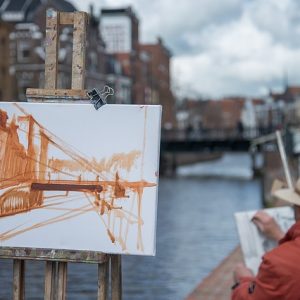
This coming summer, Grand Teton National Park (GTNP) and Grand Teton Association (GTA) are bringing the Rocky Mountain Plein Air Painters (RMPAP) to Grand Teton National Park, for a two-week plein air paint-out. The event celebrates GTA’s 75th anniversary and the Park’s storied tradition of plein air painting. The paint-out and its accompanying exhibition take place July 1-15, 2012 at the Craig Thomas Discovery and Visitor’s Center, the “focal point for GTA’s educational and interpretive efforts.” RMPAP’s show will be on display at the Craig Thomas Center, home to the Park’s permanent art collection.
Recently Jackson’s Cultural Council awarded its annual Award for Creativity to writer/filmmaker/conservationist Charlie Craighead. Craighead’s modesty and low profile belie his great contributions. Documentaries
and books such as “Artic Dance: The Mardy Murie Story,” “I’ll Meet You at the Wort,” and “Who Ate the Backyard?” touch lives, educate, entertain and, most importantly, their messages stay with us.
It’s what Craighead creates that matters; the fact that he does work within his means make his contributions that much more valuable. I’m thrilled he won, and I was also proud to nominate Jill Callaway. Jill’s contributions to Jackson’s community theatre history are extraordinary. I’d love to see the Cultural Council publish all nomination letters, so that the community can know more about the many people working to enrich our cultural scene. Here’s an excerpt from my letter:
“In 2000, Jill took it upon herself to form Jackson Community Theatre (JCT) because she believes deeply that communities need culturally based theatre. Jill does what she does because she knows Jackson is full of talent, and all talent deserves creative outlet. To that end, she insists JCT provide theatre experience for novices and seasoned actors. As the group’s leader, Jill has acted, directed, produced, stage managed, operated lights and sound, created costumes, props and sets. She oversees the company’s marketing and grants writing and manages the group’s accounting. All together, Jill has been involved in over 80 local productions….Her efforts are consistently on behalf of JCT as a whole….She is passionate about Jackson’s Western culture, its history, and family values. Many good people have lent their talents to community theatre, contributing to its longevity, but Jill provides the constant spirit, energy, and motivation propelling JCT….For 27 years, Jill has donated her time. She does not work for a performing arts company and has never received payment for her work in community theatre.”
The wave of the non-profit future must be to work within available means and facilities. Across the country, original missions have been unwittingly supplanted by underfunded real estate speculation, high salaries and high rents. There are instances, of course, of patrons and founders having deep enough pockets to build and maintain new buildings. As a friend on the West coast recently pointed out, at some point many non-profits concluded the best way to accomplish mission is to build grand facilities. Many of us were seduced. With the crash, pledges were not realized, donations slowed, costs accelerated. And although all the plans for beautiful buildings were well-meaning, these days too many original missions play secondary roles to a new mission of maintaining expensive real estate.
Hey, I have a room to rent as workspace! 250 square feet includes a full bath (two sinks!) and walk-in closet! I need help paying expenses, I’m in the same boat, ya’ll! Email me (tammy@jacksonholearttours.com) if you are interested! Seriously!
•
Wednesday, October 26, at 7:00 pm, the Jackson Hole Historical Society and Museum opens its doors for a special program. The talk, Artist Archie ‘Teton’ Teater will be presented by Dr. Teddy Khteian Keeton, a long-time friend of Teater and his wife. Keeton’s talk will focus on Teater’s early life, passion for painting, and his journey to becoming a successful artist.
Archie Boyd Teater was a painter, and a legend in his own time. His life and times are testament to the independent and eccentric artistic character typical of Wyoming. Though his name doesn’t come immediately to mind when thinking of the Western masters, Teater’s paintings have hung alongside paintings by Frederic Remington, Charles Russell, Thomas Moran and Thomas Hart Benton. Teater often “worked alongside miners, trappers and lumberjacks who had little patience or understanding for the sensitive artist, and so he would often take his wagon into the mountains, where he enjoyed the solitude, to work for days on his landscapes.”
The landscapes most inspirational to Teater were Wyoming’s mountains. According to his biography, Teater found work as a trail blazer in the newly established Grand Teton National Park. Beginning in 1928, Teater visited the Tetons annually, set up camp at Jenny Lake, and sold paintings right at his campsite. Biographers note that whenever Teater left camp, “ a note requested that art buyers pin their payments to a bed blanket.”
Teater’s log cabin gallery still stands in downtown Jackson; his Jackson Hole Art Gallery is now home to J.C. Jewelers.
Another cool fact about Teater is that he and his wife, Patricia, commissioned Frank Lloyd Wright to design and build a custom home–that house is situated in Hagerman, Idaho. Boy, would I like to take a tour; if it’s anything like Fallingwater, I’ll swoon…….Wednesday evening, enjoy stories about the artist and view some of his works. Free for members, $3 for non-members. Refreshments served! 307-733-9605. www.jacksonholehistory.org
•
Legacy Gallery has announced that artits David Mann, Merrill Mahaffey, Richard Hall, and Walt Wooten have joined the gallery. Legacy’s show Western Reflections is currently on display, and the gallery plans a Holiday Small Works Show, opening December 8, 2011. www.LegacyGallery.com
Jackson Hole artist Erin C. O’Connor will give a free plein air painting demonstration at String Lake, Grand Teton National Park on Saturday, September 10, 2011, 2:00-5:00 pm. O’Connor’s appearance winds up the Grand Teton Association’s 2011 “Artists in the Environment” plein air series, and coincides with the opening days of Jackson Hole’s Fall Arts Festival. (Tuesday, September 6th, the Jackson Hole Art Blog will post the first of two Fall Arts Festival calendars!)
O’Connor finds her greatest inspiration by painting directly within the environment. Noted for her participation in many prestigious plein air events, she is represented in collections and exhibits throughout the country. Since being awarded the 2009 Joshua Tree National Park “Artist-in-Residency”
post, she has taken part in numerous Rocky Mountain Plein Air Painters (RMPAP) events, most recently being awarded “Artists’ Choice, Best Body of Work” by her peers at RMPAP’s Pagosa Springs, Colorado competition. Plein Air Magazine’s Spring 2011 issue named the artist one of “Today’s Masters.”
“To gain the endorsements of your fellow artists–there’s no higher accolade,” O’Connor says.
O’Connor came to Jackson 25 years ago, and stays because it’s a place where she and so many others are free to “follow their bliss.” As an artist, you can never paint as much as you’d like, she says. O’Connor sees the world around her afresh daily. It’s a point of ecstasy or a point of madness–but for her, wanting to paint everything you see–and seeing everything as a painting–is a gift.
O’Connor drew and painted from the time she was little.
“When I first started painting en plein air I’d say I strove more to capture details and “true” colors than I do now,” she notes. “Now, I don’t get as wrapped up in those details. It’s the essence behind the details I want to capture. That was never a conscious decision–you’re not going to change the way you paint, it’s like your signature. My style is not really contemporary, not really traditional. The Taos Ten greatly influenced me, and the California Impressionists–the people in the U.S. who were painting outside. It was their clarity of light and brilliant color.”
Describing herself as essentially a “solitary individual,” O’Connor has lately been painting hay bales–”round bales, square bales, hay loaves, hay
laying on the ground, in stripes and in piles!” Painting alone allows her to stay in her “zone,” frees her to get into her signature style. Summers, O’Connor works as a landscaper. The job gets her outside, and she can think about how to access certain scenes.
“I’m not above stopping on the Wilson Bridge and placing orange cones around me so I can paint! But there’s usually an easier way,” says a smiling O’Connor.
A few years ago, while painting at String Lake, a Western Tanager flew down to perch on the artist’s easel.
“I don’t know if it was attracted to the colors of the paint or if it was a mooch! It was a great experience,” recalls O’Connor. “There’s so much going on at String Lake. There are the mountains, so dramatic. There’s the lake itself, quiet and serene. It’s shallow enough to see logs beneath the water’s surface, everything is so interesting, there’s so much to choose from. And it’s an honor to be asked back to “Artists in the Environment.”
NOTE: There are several parking areas at String Lake. To hook up with “Artists in the Environment,” proceed to the furthest parking area–String Lake’s Picnic Area lot. Walk a short distance north, up the shoreline, and find O’Connor “in plein sight,” alongside the lake.
Contact: Tammy Christel tammy@jacksonholearttours.com
Last spring Jackson photographer David Brookover unveiled what is sure to become one of his signature photographs, an iconic bromoil of a bison. Now, on the eve of Jackson Hole Fall Arts Festival 2011, Brookover is introducing seven new platinum palladium prints. Traditionally, Brookover has favored landscapes and ancient architecture. For over a year he’s been shooting the Greater Yellowstone Ecosystem’s indigenous wildlife and Park habitats, redefining nature photography.
The downstairs of Brookover’s Jackson gallery has been transformed into a visitors’ sanctum. “It’s a meditative space,” Brookover says. “People come down and spend 30, 45 minutes. It’s calm; upstairs has more bustle, with the activity of Gaslight Alley and Town Square just outside. On the lower level it’s cool and quiet. When folks discover these images they want to remain with the photographs.”
Brookover’s wildlife images are crafted using traditional, ancient methods and materials. Japanese printing papers are made as they were in the 1st century. These fabrics enhance Brookover’s sophisticated, minimalist compositions, resulting in a thoroughly refreshed wildlife photography style.
Brookover talked about his bromoil process.
“It starts with silver gelatin; you strip away the silver and you’re left with a matrix of gelatin and paper. “You ‘go in’ with lithographic
pure inks. Using a special Japanese brush I tap it, brush it, work it for about an hour. I let the image set overnight, throw it in water, wipe off excess ink, and then repeat that sequence…for four more days. And usually, after four days, I’m not satisfied! So we play with different exposures, work on the negative, and I think about how to apply ink once as I get further along. We started on the Buffalo bromoil a few days before Superbowl Sunday and finished it April 15—over two months to get it right. It’s a challenge for printers! But we got it.”
A bromoil image of the Great Wall of China’s has striking perspective, its solidity and details palpable. Brookover creates thick atmosphere using a brush and a density of inks to build up shadows and enhance texture. “When silver gelatin papers were developed, they were popular because it was so much easier than bromoil,” notes Brookover. “But I love the process; there’s a certain masculinity to it.”
A photograph of Yellowstone’s Firehole River is as mystic as a sacred shrine. In another shot, two young great horned owls nestle in a cottonwood’s gnarled, sheltering trunk. “Silent Storm” is a hauntingly beautiful image of a Yellowstone bison bearing up under heavy winter snows. The animal is enveloped in hot spring mists.
Fans of Grand Teton National Park’s Bears 399 and 610 will want to see Brookover’s series of photographs of those two bears and their cubs. Like pages from a private ancestral album, the platinums portray touching family moments. The series is intimate, playful, and timeless. On a wall nearby, a wolf appears to be walking across the surface of the Madison River’s glittering waters.
“These platinums and bromoils are a team effort,” says Brookover. “We love exploring historical processes. That’s where we’ve been, and that’s where we’re going.”
I recommend stopping in to see David Brookover’s new platinum and bromoil images during Fall Arts Festival. Palates & Palettes night, the gallery will raise funds to benefit the Teton Raptor Center; Raptor Center avian “residents” will be on hand. For more information, phone 307.732.3988. Brookover will launch his new website this week! Stay tuned! www.brookovergallery.com
“Ultimately, my work springs from direct experience. And so much of my experience is rooted in nature. Or, rather, the place where nature and spirituality converge. I’ve been around the world, and Jackson Hole is my home. My paintings are profoundly affected by a life-long connection to its beauty.” ~ Kathryn Mapes Turner
Jackson Hole, Wyoming - Jackson artist Kathryn Mapes Turner’s new show, By the Light of the Sun, will be on exhibit at Trio Fine Art September 7-24, 2011. An artist’s reception takes place September 8th 2011 (Jackson Hole Fall Arts Festival Opening Day), 5-8:00 pm. Turner will talk about her inspirations at 6:30 pm. The public is invited to attend this free event. Turner will be available at Trio Fine Art for the length of the exhibition. By the Light of the Sun showcases Turner’s newest collection of spectacular regional landscapes; this season, Turner’s muses are Jackson Hole’s signature aspen and cottonwood trees. Enchanted by cottonwoods’ forms and the aspen’s delicate colors, Turner explores the spaces these trees occupy, as well as the relational space between them.
Having grown up on her family’s ranch, in the middle of Grand Teton National Park, Turner recognizes sublime natural beauty. Resplendent mountains, sparkling waters and a profusion of wildlife informed her. The first girl born into a ranching family in 60 years, she experienced mountain seasons as they turned from icy, monochromatic winters to summers exploding with wildflowers, azure skies and silvery sage. Working with the land every day, Turner developed a powerful initiative and aesthetic. The need to use her hands, a powerful work ethic and a deep love for nature’s wonders converged.
Kathryn Turner became an artist. But despite nature’s pervasiveness, it’s possible Turner’s biggest influence was a store-bought poster.
“Over my bed was a poster of Vermeer’s “Girl With a Pearl Earring.” I think about how someone had used paints, brushes and canvas to
create something so moving, I gazed at it every day.” Turner believes that if she is going to create anything material, she must do it to the very best of her ability.
Executing such work is a huge responsibility. As she works, Turner stays in contact with her own powerful sense of spirituality. “Whatever the concept of God or “oneness” is, that is where beauty, truth and goodness originate,” Turner says. “I want those to be the source of my work. In that sense my paintings come from another place, and not from me.”
Turner also views herself–and other artists–as part of art history’s continuum. With every painting, she strives to transmit a collective idea of sublime universal beauty. “We are a service industry,” says the artist. “I am positioned on an eternal timeline of artists, making contributions to the world. I feel I have a great opportunity and privilege by participating in the movement; it’s an incredible honor.”
It’s almost impossible not to compare Turner’s recent, tempestuous portraits of the Tetons to the paintings of the 19th century British Romanticist William Turner. Romanticism has been described as a movement so varied, it is difficult to define. A romantic herself, Kathryn Turner paints from the heart. Steering away from a collective tendency to render the Tetons in
painterly, dense layers of bright colors Turner recently painted the Grand Teton and its neighboring summits as dark and looming. These Tetons are primordial. Sweeping towards the heavens, their silhouettes are smoky and golden. Brushwork is less visible, and a holy luminosity prevails.
Contemporary Western artists often argue that the Tetons have been painted so often, any new portrayals are redundant. Turner’s recent panoramas prove that theory wrong.
“If I avoid painting the Tetons for fear of their being trite, it would be dishonest,” Turner says. “I’ve grown up with them, have always been near them, always been taken with them. How can one not be? The mountains are our central force. You can’t deny them. I need to address them in my work; I have a deep relationship with them.”
And, like the Romanticists, Turner changes up her painting style, moving on once she’s explored a subject. For her, pushing the envelope swells experience, and Turner points out that throughout art’s history, art changes. It has to, in order to remain interesting and significant. She never knows how a show will take shape, and that’s how exciting work happens.
Turner’s paintings are as much about materials as they are subject and soul. Textures and paint behavior are intriguing. Working with paint is an end in itself. As she talks about paint, she brings out a small oil of a sun splashed window box, spilling over with roses, painted in Italy.
“Transparency versus opaqueness. Thinness and thickness, bright versus dull. Oil paints give all of that, I’m in love with manipulating paint,” Turner emotes. The glazes, the scumbling—sometimes it’s about brushstrokes, sometimes it’s about drawing. Negative and positive spaces. It’s like playing in a sandbox, the possibilities are endless!”
When a painting is complete, it’s time to let it go.
“Letting go of a painting is like letting go of a child; you have to let it out into the world. The story of Pygmalion is largely about not being able to let go. If you try too hard to control
a process, it won’t flow. The paintings need to do their work in the world. Preparing work for the gallery is great because it gives me a deadline. The paintings I have the hardest time parting with are the ones most important to release. I had a teacher tell me never to call myself an artist. To call myself a painter. ‘You are a painter,’ she said. ‘Others can decide if what you make is truly art!’ So that is it. I am supposed to show up, do my best, and create from the heart.”