Posts Tagged ‘Science’
Martin Luther King Murals & a Dream
(This essay was written January 2008, inspired by tributes to Martin Luther King. This month, we are inspired by our new President-elect, Barack Obama. Also, a reminder that this website’s content protected by copyright–TC)
The day before our nation celebrated Dr. Martin Luther King’s birthday, I went to the gym. Alone in the place for over half an hour, I plodded along on the treadmill, channel flipped and considered my future and the future of Jackson Hole. How would they be tied together in the coming years? How would my new business, Jackson Hole Art Tours, fare? Would it be a rewarding experience, working to weave this new venture into Jackson’s tapestry? And would the business truly give back, and make a difference, as I hope?
After a while Franz Camenzind arrived, and now we were two. Not long ago I’d sent a note to Franz, an emotional response to the Jackson Hole Conservation Alliance’s holiday meeting and party. The evening featured Charlie Craighead’s slide presentation about his life growing up with wildlife, and how our relationship with wildlife has had to change as people flood to the valley and we develop more and more land. It was a wonderful evening, spent with some of Jackson’s most creative and change-making citizens. The crowd was warm, optimistic; everyone seemed bright with hope.
And hope is everything.
I clicked over to the Tennis Channel, looking for Nadal’s Australian Open quarterfinal match. It wasn’t on, and I complained to Franz. In the second I looked away from the screen, Franz said, “Isn’t that it?” I looked up, and there was Nadal.
“Anything else you’d like me to make happen?” Franz teased.
“Yes,” I replied. Boo-yah, my own personal genie! “I’d like you to make me the person who wakes everyone up to the true connections between the arts and conservation. I want to be that person here by 2010 and I want to instigate a dynamic, creative project that will draw everyone’s attention to the fact that, now, our environment and arts cannot survive without one another.”
Remember, I’m on a treadmill here. And those weren’t my exact words, but they’re close enough.
I sensed Franz doubted the validity of my theory. But he humored me. “Think about it,” I said. It takes creativity to communicate the beauty and utter indispensability of our natural world. Consider, for a second, the void of a world with no painters, sculptors, writers, and all manner of artists sending up messages about the earth? And where would artists be if not for our planet’s magnificence? What else inspires infinite prayers, offered via a brush, or a pen, or a camera’s lens? We would be living in a hellish, cold place. Bleak.
Art testifies, and as one of my favorite writers, Scott Russell Sanders has written, we’re telling the holy.
Franz nodded, then asked me: “But what came first, the natural world or artists?”
The natural world, of course.
Having previously lived in Jackson, I returned five years ago. To hasten reconnecting to the valley, I attended the January 2004 ‘Greater Yellowstone Power of Place’ conference. Panel ‘teams’ made presentations and talked about their connections to one another. I attended the Arts and Environment discussion. The fact that the Arts and Environment panel had been conceived as an obvious duo struck home. I recall that while all the panel members honored each other’s work and visions, there was an impasse when it came to actually naming a tangible project that would allow everyone there to contribute, and that would provide something of educational value. Stoked by the conference energy, but feeling shy and new girlish, I didn’t speak up. However, I did describe a vision I had to one of the conference organizers.
I imagine a giant, interactive screen. Glowing, luminous. This screen would depict everything within the Greater Yellowstone Ecosystem: terrain, wildlife, flora, our rivers, lakes, weather, the sky, and snow—everything indigenous to our region. The screen’s function would be to educate the user about how development, global warming, water and air pollution, and human traffic change our ecosystem’s balance. For example, if someone wanted to know how five (or any number) of drought years would affect either wildlife, our rivers and lakes, forests and wilderness, they would touch a certain spot on the screen and the screen’s technology would transform its image to depict those effects: trout would having a tough time, declining lakes, all wildlife being challenged to find nourishment, parched grasses and trees. The number of wildfires would grow, and with those come smoky skies. That’s the short list, of course. The picture would be redrawn.
Artists could imagine and render images. Conservationists and scientists would inform these artistic choices, be the books behind the art. And technology would figure out how all the components would function, build in images and text. There would be nothing like it in the world. This reflection of us would be its own technological museum, and any kid could use it, and want to use it. Adults would want to use it, as we use our computers and I-phones.
This morning, on Martin Luther King Day, I flipped on my computer to scan the New York Times E-paper headlines. Photographer Camilo José Vergara has documented 12 urban murals of King; many are in Los Angeles and New York. He says such portraits of King are everywhere. One mural depicts King as the center figure in a triptych of images that includes Jesus and the Virgin Mary. One depicts him with Pope Paul—he’s also with Nelson Mandela and Malcolm X. Another shows King as a great teacher. And one portrait paints King’s image as a strong, confident leader atop a mountain of really hip graffiti art.
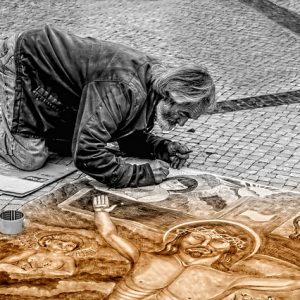
On any given holiday Google incorporates relevant artwork into its home page graphics. Today three boys are drawing a chalk portrait of Martin Luther King on the sidewalk. How wonderful is it that the artists are young kids? How do they know about Martin Luther King? What inspired them to draw his image?
Viewing these powerful, beautiful and respectful images, I was reminded of the recent political flap over whether King was responsible for igniting racial reform, creating its destiny and bringing his message home, or if this was Lyndon Johnson’s victory.
Who first brought the Dream?
Martin Luther King, of course.
–Tammy Christel
January 21, 2008