Archive for the ‘Think Globally’ Category

Martin Luther King Murals & a Dream

Wednesday, November 12th, 2008

(This essay was written January 2008, inspired by tributes to Martin Luther King. This month, we are inspired by our new President-elect, Barack Obama. Also, a reminder that this website’s content protected by copyright–TC)

The day before our nation celebrated Dr. Martin Luther King’s birthday, I went to the gym. Alone in the place for over half an hour, I plodded along on the treadmill, channel flipped and considered my future and the future of Jackson Hole. How would they be tied together in the coming years? How would my new business, Jackson Hole Art Tours, fare? Would it be a rewarding experience, working to weave this new venture into Jackson’s tapestry? And would the business truly give back, and make a difference, as I hope?

After a while Franz Camenzind arrived, and now we were two. Not long ago I’d sent a note to Franz, an emotional response to the Jackson Hole Conservation Alliance’s holiday meeting and party. The evening featured Charlie Craighead’s slide presentation about his life growing up with wildlife, and how our relationship with wildlife has had to change as people flood to the valley and we develop more and more land. It was a wonderful evening, spent with some of Jackson’s most creative and change-making citizens. The crowd was warm, optimistic; everyone seemed bright with hope.

And hope is everything.

I clicked over to the Tennis Channel, looking for Nadal’s Australian Open quarterfinal match. It wasn’t on, and I complained to Franz. In the second I looked away from the screen, Franz said, “Isn’t that it?” I looked up, and there was Nadal.

“Anything else you’d like me to make happen?” Franz teased.

“Yes,” I replied. Boo-yah, my own personal genie! “I’d like you to make me the person who wakes everyone up to the true connections between the arts and conservation. I want to be that person here by 2010 and I want to instigate a dynamic, creative project that will draw everyone’s attention to the fact that, now, our environment and arts cannot survive without one another.”

Remember, I’m on a treadmill here. And those weren’t my exact words, but they’re close enough.

I sensed Franz doubted the validity of my theory. But he humored me. “Think about it,” I said. It takes creativity to communicate the beauty and utter indispensability of our natural world. Consider, for a second, the void of a world with no painters, sculptors, writers, and all manner of artists sending up messages about the earth? And where would artists be if not for our planet’s magnificence? What else inspires infinite prayers, offered via a brush, or a pen, or a camera’s lens? We would be living in a hellish, cold place. Bleak.

Art testifies, and as one of my favorite writers, Scott Russell Sanders has written, we’re telling the holy.

Franz nodded, then asked me: “But what came first, the natural world or artists?”

The natural world, of course.

Having previously lived in Jackson, I returned five years ago. To hasten reconnecting to the valley, I attended the January 2004 ‘Greater Yellowstone Power of Place’ conference. Panel ‘teams’ made presentations and talked about their connections to one another. I attended the Arts and Environment discussion. The fact that the Arts and Environment panel had been conceived as an obvious duo struck home. I recall that while all the panel members honored each other’s work and visions, there was an impasse when it came to actually naming a tangible project that would allow everyone there to contribute, and that would provide something of educational value. Stoked by the conference energy, but feeling shy and new girlish, I didn’t speak up. However, I did describe a vision I had to one of the conference organizers.

I imagine a giant, interactive screen. Glowing, luminous. This screen would depict everything within the Greater Yellowstone Ecosystem: terrain, wildlife, flora, our rivers, lakes, weather, the sky, and snow—everything indigenous to our region. The screen’s function would be to educate the user about how development, global warming, water and air pollution, and human traffic change our ecosystem’s balance. For example, if someone wanted to know how five (or any number) of drought years would affect either wildlife, our rivers and lakes, forests and wilderness, they would touch a certain spot on the screen and the screen’s technology would transform its image to depict those effects: trout would having a tough time, declining lakes, all wildlife being challenged to find nourishment, parched grasses and trees. The number of wildfires would grow, and with those come smoky skies. That’s the short list, of course. The picture would be redrawn.

Artists could imagine and render images. Conservationists and scientists would inform these artistic choices, be the books behind the art. And technology would figure out how all the components would function, build in images and text. There would be nothing like it in the world. This reflection of us would be its own technological museum, and any kid could use it, and want to use it. Adults would want to use it, as we use our computers and I-phones.

This morning, on Martin Luther King Day, I flipped on my computer to scan the New York Times E-paper headlines. Photographer Camilo José Vergara has documented 12 urban murals of King; many are in Los Angeles and New York. He says such portraits of King are everywhere. One mural depicts King as the center figure in a triptych of images that includes Jesus and the Virgin Mary. One depicts him with Pope Paul—he’s also with Nelson Mandela and Malcolm X. Another shows King as a great teacher. And one portrait paints King’s image as a strong, confident leader atop a mountain of really hip graffiti art.

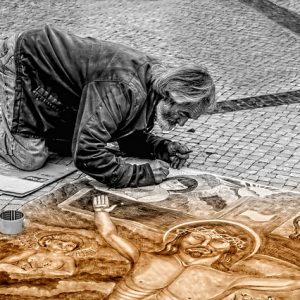
On any given holiday Google incorporates relevant artwork into its home page graphics. Today three boys are drawing a chalk portrait of Martin Luther King on the sidewalk. How wonderful is it that the artists are young kids? How do they know about Martin Luther King? What inspired them to draw his image?

Viewing these powerful, beautiful and respectful images, I was reminded of the recent political flap over whether King was responsible for igniting racial reform, creating its destiny and bringing his message home, or if this was Lyndon Johnson’s victory.

Who first brought the Dream?

Martin Luther King, of course.

–Tammy Christel
January 21, 2008

Obama’s Creative Campaign

Thursday, November 6th, 2008

“Not only is arts education indispensable for success in a rapidly changing, high skill, information economy, but studies show that arts education raises test scores in other subject areas as well. “   -Obama Campaign

“Creative America for Obama” is the official arts group of the Obama for America campaign. Now that campaign furor is at rest, (we’re all resting, I think!) it seems auspicious to recap Obama’s campaign official arts platform.

Yes, there’s an arts platform supporting and advocating for the arts as a powerful economic factor in America’s education and economy.

To compete globally, the U.S. needs to support and invest in all creative efforts, starting with our children’s arts education. Arts translate into science and technology and are crucial in encouraging creative thinking.

Says the NEA Chairman:

”The purpose of arts education is not to produce more artists, though that is a byproduct. The real purpose of arts education is to create complete human beings capable of leading successful and productive lives in a free society.”

Although it would be some kind of miracle if these issues are addressed during Obama’s first term, Obama has said that he will:

• Work to expand public and private partnerships between education and the arts by increasing resources for the U.S. Department of Education’s Arts Education Model Development and Dissemination Grants…”

• Work to create an ”Artists Corps” to work in low-income schools and their communities.

• Support increased funding for the NEA.

• Promote Cultural Diplomacy—Obama’s campaign goes so far as to say that, “Artists can be utilized again to help us win the war of ideas against Islamic extremism.” Additionally, Obama feels attracting a foreign arts community to America will open more diplomatic doors and create greater cross-cultural dialog. Obama and Biden will also work to streamline visa application processes.

• Provide health care to artists by acknowledging the unique needs of artists not receiving employee coverage and financially unable to carry their own health insurance.

• Ensure tax fairness for artists. This includes enabling artists to deduct fair market value for their work, rather than just the cost of materials. See the “Artist-Museum Partnership Act,” introduced by Senator Patrick Leahy (D-VT).

End

Arapaho School & “The New Gold Rush” at TCL

Monday, November 3rd, 2008

Teton County Library installs excellent visual arts exhibitions. If you haven’t already done so, don’t forget to check out “Netniintoonoo, “The Place Where We Live,” on view through November 10. This photography exhibition was created by students of the Arapaho School as part of the Language Revitalization Project on the Wind River Reservation.

Information on TCL’s next exhibition, currently posted on their website, is below:

November 13-December 30 the Teton County Library hosts a provocative exhibit focusing on coalbed methane drilling, “The New Gold Rush: Images of Coalbed Methane.” See the changes sweeping the open range with this unusual exhibit, combining photographs and satellite images. Four artists, John Amos, Ann Fuller, Patrick Smith and Ted Wood, chronicle how natural gas drilling is altering northern Wyoming’s Powder River Basin. They provide a portrait of the people and the place, now being crisscrossed by pipelines, utility lines, roads, well pads and other changes from the energy boom. On view during regular library hours, Nov. 13 to Dec. 30. Cost: Free. Location: Library’s Exhibit Gallery. Contact: Adult Humanities Coordinator, 733-2164 ext. 135.

End

Celebrate Traditional “Day of the Dead” at LMC & TCL

Wednesday, October 29th, 2008

Need a break from the election treadmill?

Sunday, November 2 celebrates Mexico’s “Day of the Dead,” a holiday that, despite its name, celebrates life.   It’s a wonderful holiday, filled with creativity and possibility.  Jackson traditionally holds a “Day of the Dead” walk, a guided tour of local “Day of the Dead” altars around town.   Altars are an invitation to the departed to celebrate with those of us still of this world, and to that end altars feature costumed figures, humor, artistry, and food.

Lyndsay McCandless Contemporary, in conjunction with Ladrillos par alas Artes and the Teton County Library, will provide party space and special classes.

Festivities take place at LMC, 130 South Jackson Street, on Sunday, November 2, 5:30 – 9:30 pm.  Other scheduled events follow, and families are welcome!

At LMC, view “Day of the Dead” altars, decorate a sugar skull, watch traditional craft demonstrations and enjoy homemade tamales, “dead bread” and Mexican hot chocolate.

Cooking classes and sugar skull class is limited to 12 participants. Reserve a spot by calling Oona Doherty at 690-5264, or email oonadoherty@gmail.com

Other “Day of the Dead” Events:

Look for a Stagecoach Stop Halloween altar installation on the Town Square, created by local artists on Friday, October 31 from 4-8pm.

Thursday, October 30
Cooking Class: Mole Poblano taught by Marta Arribillaga
6-7:30pm
Location:  e.leaven Food Company

Mole is a common dish prepared during Dia de los Muertos.  Participants will learn how to make chicken mole with rice and will eat the final product.

Saturday, November 1
Live Altar Performance directed by Raul Juarez
11-11:30am
Presented by the Teton County Library

Watch a short “Day of the Dead” theater piece followed by traditional Mexican food and sweets. For ages 5 and up.

How to make a traditional Altar with Laura Rodriguez
Teton County Library Auditorium
12-12:30pm

Sugar Skull Decorating taught by Bronwyn Minton
1-2pm Children 5 and up
2-3pm Adults
Library Conference Room
Participants will learn how to make sugar skulls (Calaveras de Azúcar) using a mold and decorate a skull to take home.

Baking Class: Pan de Muertos & Champurrado with Blanca Rojas
4-6pm
Location: Hard Drive Café!
Pan de Muertos (Bread of the Dead) is sweet and shaped into skulls or round loaves with strips of dough on top to resemble bones. Champurrado is a warm, thick beverage made with ground corn and chocolate.

END

Economic Development for…Rural Towns

Saturday, October 4th, 2008

By Forrest Miller

The first principle to grasp is that solving economic problems is not a short-range project. The problems you are facing are most likely the results of years of trends and may take years to solve. If your community does not have current problems, then your goal must be to prevent them. Quick fixes and buzzword projects usually work only for the consultant who gets paid to present them. I have a suggested list of activities to help you organize. My suggestions are based on my own experiences, both good and bad. Certainly, there are many other ways to approach economic development.

GETTING STARTED

1. Organize your group: I would suggest that you start with a small key group of community members. These members should be stakeholders in the community and people who are directly affected by the economy. I would not recommend that this be a governmental commission or any other public body where open meetings are required. Early on, your work should be confidential, as you will be addressing controversial issues. The goal of this group is to lay the groundwork; public input will come later. Members on this task force should be there for the long run. A real problem with most groups is that they want to organize like a service club with annual elections and rotating members. It is better to look at this group as being there for the long run with gradual changes in leadership and members. The service club approach results in leaders trying to get short term programs in during the year they are the chairperson so that they look successful.

2. Begin to define the problem: You may think you know what the problem is when in reality you are looking at a symptom. For example, many communities will state that the problem is not enough jobs. That may really be the symptom of other economic factors that are preventing business growth in the area. No problem stands alone. They are always interrelated to other problems. For example, business growth may be hampered by the lack of sewer capacity, which in turn is caused by lack of funds, which is caused by a low tax base. Define your problems in the light of what would be needed for a total solution. You will need to take into consideration all factors of a community including infrastructure, work force, education level, available industrial and business sites, competition, political situation, life style, and so forth. I am not going to outline all the factors because if you are serious you and your group will be doing some research and reading about the subject. Your State University will have reams of material for you. If you are serious, educate yourself. Amateurs usually do not.

3. Prepare a list of all economic development resources: Every state has a myriad of economic development agencies. Most counties and regions have economic development organizations of some sort. It has become almost mandatory in order to receive a Federal or State grant that some element of economic development is being done. On top of all this, there are hundreds of consulting groups, both non-profit and for profit. Universities, Colleges and Jr. Colleges usually have some program that is related to economic development. Our goal is not to list these for you but to have you search them out. Start at the state level and work down. You will also need to contact Federal level help such as the Dept of Agriculture’s Rural Development Agency and the Economic Development Agency (EDA). There are others such as housing related agencies. So keep looking.

Contact as many of these organizations personally as you can and build a database of what services are available to you. Ferret through the claims and discover what concrete services they can do in your town. Most organizations involved in economic development are not paid for results; they are paid for programs. Programs earn grants, which cover the overhead. The results of the programs are hidden behind the smoke and mirrors or buzz words like “planning”. Get down to the real deliverables that you can use in your community. Planning may well be one of the deliverables, but you will need others.

4. Think globally, interact regionally; and act locally. Get this attitude in concrete into the mission statement of your organization. Avoid the “poor me” syndrome so often heard from rural areas. Everybody has problems. In fact, often more Federal help per capita is available in rural areas than in urban areas. Avoid the wasteful and rude “Us versus them” attitude. Also, stay away from political nonsense. It is a fact of life that more voters live in urban areas than in rural areas. Some popular legislative agendas in urban areas that are in conflict with rural values, such as some environmental issues, are just facts of life. Concentrate on what you can change. All you can do on the other is to provide education about your point of view, but don’t waste your budget on dead horses.

STEP TWO AFTER GETTING STARTED

1. Decide how you are going to finance your organization. Avoid the common trap of claiming that other organizations are not doing their job; and therefore, the City or County should pay you instead. If you are smart, you will use their resources, let them pay the admin costs and you will concentrate directly on your mission. Get your own sources of funding for your mission. If you are perceived as being part of the solution, you will be able to collect dues and donations from the stakeholders. Later on, if you are successful, you may be able to get grants from organizations such as Rural Development.

2. Avoid the trap of thinking that you must have paid staff. Well-organized volunteers can run an excellent program. In fact, if the organization can not run a good volunteer outfit, it will not be better with paid staff and the funds will just go into admin. There may be a time later for paid staff, but not now.

3. Avoid the trap that you must raise funds to hire some guru. A successful promoter in another town may have simply been in the right place at the right time. If your budget is large enough, there may come the time to hire a specialist to run your organization; but you do not have to start that way.

4. Use consultants warily. We will talk about this later.

5. Get public input and build consensus. There are many ways to do this. I like to believe that in the end, the old fashion American way of debate results in the best way to drag out hard issues, identify them, and address solutions. A variety of consensus building methods exist and the academic community will provide help in staging them. Visioning is a method of bringing the community together to discuss issues. Your State University can probably provide a facilitator for such a meeting. Consultants will often hold community-visioning meetings. Be careful. Some of these meetings have an agenda to lead the community to their program as the solution to the problems addressed. The problem with these methods is that often the community is left with a warm fuzzy feeling without hard issues being resolved. Group consensus building often centers on what people will agree on while; in reality, what they disagree on are the real issues. The social pressure in the meeting may prevent dissenters from speaking up. I have seen many organizations hold visioning meetings, develop a program based on consensus, and then just get creamed by an opposition group that forms because real issues were not addressed. Community meetings often raise expectations, leaving you holding the bag when they do not materialize. Community input is important but it cannot all come from open meetings. Some stakeholders will not state their view in public but will become very active if they perceive their interests being at risk. The community may not even want development. Some rural communities have business interests that want development and residents who moved there hoping that no growth would occur. In the end run, your group may have to slowly build community support by selling your program while addressing the concerns of the community. Few great leaders or great movements ever started with “community consensus”. At any rate, you must find out what the community will support and what it will not support at this time. This is your starting point.

6. Redefine your list of problems after the community input. Prioritize in terms of what is needed most from an economic viewpoint and then list in order of what the community will support at this time. Then, in light of both lists, prepare a list of problems in the order you will tackle them. The top few of these will become your immediate goals and the rest become long term goals. Eliminate those that are just plain impossible. For example, if the rail line has been pulled up and the right away sold, it is probably impossible to get the railroad back. You may have to build community support for important goals that just can not be started now because of community opposition.

7. Prepare a list of community resources. This should be a brainstorming session. No idea is stupid. My interest in collecting leaves may sound stupid to you but perhaps enough people exist with that interest to become a tourism resource. This list will include business sites, industrial sites, existing businesses and existing employers, medical facilities, tourist attractions, what you like about the area, what your relatives like about the area, utility resources, weather, and so forth.

8. Prepare a list of all sources of personal, business, and public income to the community. Federal and State agencies can help with this. This list will include all employers, both private and public, retirement incomes, transfer payments, welfare, and other sources of personal income. Public income will be taxes, transfer payments, grants, and other entitlements. Business income sources will be retail, services, manufacturing, recreation, farming, timber, mining, industrial, and other sources. You must clearly identify all sources of money coming from the outside into the community. Again, this is not only from the sale of goods and services but also such items as retirement income. It is this external income that drives your internal economy. Your internal economy is the sale of goods and services by local businesses to local residents and local businesses. This information will allow you to address expansion and retention issues.

STEP THREE, DO IT

1. After assembling all the data, it is time to start action. This is an ongoing process of planning, funding and organizing, doing, evaluating, correcting, doing again. We will talk more about this process later. Most activity will fall under the following actions.

* Retention: This is the process of helping to keep the industry, business, and economic activities you have.

* Social and educational climate: This is the process of improving the town you live in through having better educational facilities, better housing, lower crime rate, and similar areas of concern. This is often part of a recruiting effort.

* Gardening: This is the effort to develop local entrepreneurs who will start businesses. This effort ranges from technical assistance to peer support groups.

* Recruiting: This is the effort to attract outside firms to locate to your community. This is probably the most difficult approach to be successful in but it may have the highest payoff if you succeed. e.

* Recreation and Tourism: This is the effort to develop local resources as to attract tourists. Recreational efforts range from targeting day use populations from local urban areas to efforts to become a destination resort.

* Outside incomes: This is the effort to attract retirement populations and others such as lone eagles whose incomes come from outside sources but who spend money locally. Lone eagles are self-employed persons who often sell expertise or consulting but prefer to live in a rural area. Artists would be similar. Lone eagles often have high incomes. Usually they have started their business elsewhere but retain the clients when they move to a rural area.

* Electronic infrastructure: This is the effort to modernize the communications system in the area, such as installing fiberoptics in order to connect with the outside world and allow electronically based information systems to be used locally. Also, this may allow Internet based businesses to exist.

* Infrastructure: This is the effort to provide community services, building sites, sewer, water, and other services so that the community can handle growth.

* Build it and they will come: This is the effort to build, often with public money, business or industrial sites for sale or rent in order to attract business or industry. Often low rates are offered as an incentive.

* Incentives: Monetary incentives offered by States and communities to expanding businesses, recruited businesses, and sometimes to retain businesses. These range from cash payments to tax breaks. Incentives vary greatly between States and communities.

* Life Style: This is recruiting by selling the good points of a community. Rural communities often market the safe and low stress lifestyle along with the natural beauty of the rural setting.

* Leakage: This is the effort to bolster the internal economy of a community by combating buying patterns where residents purchase goods and services outside the community such as in urban malls or through the internet. This may include downtown revitalization programs such as walkable down towns, historic districts, and similar efforts to rebuild down town cores. Customer service training may be a part of stopping leakage.

* Planning: This is the process of setting economic objectives, each player’s part, and the method to achieve those objectives.

There are others, but these are the primary efforts most communities use.

2. Based on the needs you have identified, your resources, and the method you chose, you would now initiate plans and committees to carry out those plans. I cannot tell you what method to use nor if it will succeed. However, there are ways to approach the problem. As you formulate your courses of action, you should develop the partners who will help you. For example, if your goal were to increase tourism, you would partner with state and regional tourism agencies. The process is to identify problems, resources (both community and outside), advantages, obstacles, and goals. Once these are identified and a course of action is picked, the committee handling this goal will set up partnerships with available resource agencies and begin the work. Of course, a budget is set for this and also a review process.

3. Limit your projects to a realistic number based on your organization and its budget. You will do better if you do a few things well as opposed to doing a lot of things poorly.

4. Use consultants when possible. Some are free through Universities and government. Remember that often consultants are in the business of pushing their companies or their particular approach. They can be very successful if you get the right match for your problems. Check them out. Call towns they have worked for and see what results were achieved. See if results were still there several years later. Check for hard results, not just that everyone really enjoyed the program.

5. Likewise, try to find other communities similar to yours and see what has really worked. Look at an expanse of time and not just the last few months. Learn from others. You can copy successes when it makes sense and you can avoid duplicating mistakes.

6. Stay in the economic development loops. Remember; think globally, interact regionally, and act locally.

7. Put your programs in motion. Quit talking and start doing. If you are going to recruit for example, then learn how to do it and give it a try. Your organization now moves from planning to action.

THE LAST STEP: EVALUATION

In this business of development, nothing is carved in stone. New approaches, trends, and changes in the economy all put us in an always-changing environment. It is important that you recognize trends, both locally and globally. When rural communities did not recognize the retail-shopping trend towards urban malls, they were devastated when change left them without customers and not enough time to fight back. Evaluation is the process of seeing how things are going and to change the process if needed. We talked earlier of the management process steps of planning, funding, organizing, doing, evaluating, correcting, and doing again. This is a never-ending chain. Always be prepared to drop programs that do not work and start new ones if needed, or to change existing ones. Quarterly progress reviews are a good idea for your board. Avoid sacred cows or pet projects that continue to exist in spite of being ineffective. Evaluate projects on real results, not warm and fuzzy feelings. Too many dollars are spent on programs that really deliver nothing directly to the community. People will eventually see through this and support for such programs from the public will drop. Be real!

In the evaluation process, encourage input from the public and from local government. Be prepared to handle criticism. Listen, and if the input indicates the need for change, then be willing to change. Also be willing to defend what you are doing if it is really of value to the community. You are looking for input from these sources, not management of your organization by these sources.

Good Luck. I hope that you have thick skin, dedication, and a great sense of humor.


Contact Forrest M. Miller via e-mail at:  wheatcountry@aol.com


| Sommaire |

Horizon Local 1997
http://www.globenet.org/horizon-local/