Posts Tagged ‘Wyoming’
Have you heard of USA Artists? Or Pipeline to Miami?
I hadn’t, until I stumbled upon Pipeline’s home page. Pipeline is a Wyoming arts philanthropy project, the first of its kind in our Big Square State, and a sub-project of USA Artists. Pipeline’s goal is to send three Wyoming artists—David Klarén, Sue Sommers and JB Bond—to Florida’s Red Dot Art Fair. Red Dot, a Miami Art Week venue, takes place early December. Rather than paraphrase Pipeline’s mission, I’ll provide an excerpt:
“The Pipeline Art Project started with a handful of Wyoming contemporary visual artists realizing they all wanted the same thing: to live in the place they love, and to have viable art careers. But art opportunities are usually found in higher-population areas. We knew that to market our work outside the state, we needed to pool our ideas and resources. So we created the Pipeline Art Project: “Pumping Art from the Energy State of Wyoming.” Wyoming is better known for exporting coal, oil and gas than for its dedicated and talented contemporary artists. It’s the perfect place to make art, but a very tough place to build an art career. Pipeline wants to change that. We are trying to create a conduit to an international audience and better opportunities for ourselves and others.”
Providing techniques that move artists’ work to larger U.S. art market venues takes Wyoming arts support to new levels. It gets us thinking beyond sharing our great talents with each other. Intramural art missions will always be essential, but most Wyoming artists don’t have the means to get to art show venues outside the state. I hope Pipeline’s model earns its wings. Pipeline’s web page gets updated; at this writing the project has raised $3,750 of its $8,000 goal. Forty days left to help out! http://www.unitedstatesartists.org/project/pipeline_to_miami
•
Jackson artists Jennifer Hoffman and Kathryn Mapes Turner entered an elite juried art show—the 12th Annual American Impressionist Society Exhibition in Carmel, California— and came back with big ribbons. Turner’s winning, “Best of Show” oil painting Siena
depicts a Italian church courtyard in Tuscany. Hoffman’s pastel, Allegory, won Plein Air Magazine’s “Award of Excellence.” Both artists are represented locally by Trio Fine Art.
Hoffman’s award includes ad placement in Plein Air Magazine. “I loved meeting so many incredible artists whose work I really admire,” says Hoffman. “I also was able to participate in the AIS paint-out the following day on Fisherman’s Wharf in Monterey, surrounded by beautiful scenery, talented AIS artists from all over the country, and enthusiastic tourists who seemed to really enjoy the event. All in all, the whole trip was energizing, inspiring, and really, really special.”
“I felt honored just to be accepted into such an important exhibition” says Turner. “Once I saw the high level of talent displayed, I was humbled and thrilled to receive their highest honor.” Turner says she was intrigued by the scale of human figures as set against massive marble church walls. Monochromatic colors lent a sense of harmony, and the setting was a great chance to explore composition and reflecting light.
“It’s an honor just to get into the American Impressionist Society show, one of the best juried shows I’ve taken part in,” adds Hoffman.
Scott L. Christensen was this year’s exhibition judge; he bestowed both awards. “Knowledge is a catalyst to completing a painting,” says Christensen. “But it must have a force behind it, a certain ‘seeing’ that is distinctly your own and developed through time.” www.americanimpressionsitsociety.org
•
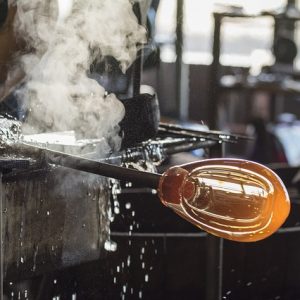
Ralph Mossman and Mary Mullaney—known collectively as Heron Glass—are happy to say they’re back in the creative, glass-blowing mode. The shop has announced two holiday bazaars: Saturday, December 3, 2011 visit Heron Glass at the Art Association’s 2011 Christmas Bazaar. Saturday, December 10, visit Heron Glass at their Driggs, Idaho studio from 10 am – 5pm. Address: 240 Nth 5th Street, Driggs. 208-354-2759 www.heronglass.com
•
Etcetera—-Mountain Trails Gallery has renamed itself. The gallery will now be known as Mountain Trails Gallery Jackson Hole…..Cayuse Western Americana has a great new website!……David Brookover has a great new website!
Recently Jackson’s Cultural Council awarded its annual Award for Creativity to writer/filmmaker/conservationist Charlie Craighead. Craighead’s modesty and low profile belie his great contributions. Documentaries
and books such as “Artic Dance: The Mardy Murie Story,” “I’ll Meet You at the Wort,” and “Who Ate the Backyard?” touch lives, educate, entertain and, most importantly, their messages stay with us.
It’s what Craighead creates that matters; the fact that he does work within his means make his contributions that much more valuable. I’m thrilled he won, and I was also proud to nominate Jill Callaway. Jill’s contributions to Jackson’s community theatre history are extraordinary. I’d love to see the Cultural Council publish all nomination letters, so that the community can know more about the many people working to enrich our cultural scene. Here’s an excerpt from my letter:
“In 2000, Jill took it upon herself to form Jackson Community Theatre (JCT) because she believes deeply that communities need culturally based theatre. Jill does what she does because she knows Jackson is full of talent, and all talent deserves creative outlet. To that end, she insists JCT provide theatre experience for novices and seasoned actors. As the group’s leader, Jill has acted, directed, produced, stage managed, operated lights and sound, created costumes, props and sets. She oversees the company’s marketing and grants writing and manages the group’s accounting. All together, Jill has been involved in over 80 local productions….Her efforts are consistently on behalf of JCT as a whole….She is passionate about Jackson’s Western culture, its history, and family values. Many good people have lent their talents to community theatre, contributing to its longevity, but Jill provides the constant spirit, energy, and motivation propelling JCT….For 27 years, Jill has donated her time. She does not work for a performing arts company and has never received payment for her work in community theatre.”
The wave of the non-profit future must be to work within available means and facilities. Across the country, original missions have been unwittingly supplanted by underfunded real estate speculation, high salaries and high rents. There are instances, of course, of patrons and founders having deep enough pockets to build and maintain new buildings. As a friend on the West coast recently pointed out, at some point many non-profits concluded the best way to accomplish mission is to build grand facilities. Many of us were seduced. With the crash, pledges were not realized, donations slowed, costs accelerated. And although all the plans for beautiful buildings were well-meaning, these days too many original missions play secondary roles to a new mission of maintaining expensive real estate.
Hey, I have a room to rent as workspace! 250 square feet includes a full bath (two sinks!) and walk-in closet! I need help paying expenses, I’m in the same boat, ya’ll! Email me (tammy@jacksonholearttours.com) if you are interested! Seriously!
•
Wednesday, October 26, at 7:00 pm, the Jackson Hole Historical Society and Museum opens its doors for a special program. The talk, Artist Archie ‘Teton’ Teater will be presented by Dr. Teddy Khteian Keeton, a long-time friend of Teater and his wife. Keeton’s talk will focus on Teater’s early life, passion for painting, and his journey to becoming a successful artist.
Archie Boyd Teater was a painter, and a legend in his own time. His life and times are testament to the independent and eccentric artistic character typical of Wyoming. Though his name doesn’t come immediately to mind when thinking of the Western masters, Teater’s paintings have hung alongside paintings by Frederic Remington, Charles Russell, Thomas Moran and Thomas Hart Benton. Teater often “worked alongside miners, trappers and lumberjacks who had little patience or understanding for the sensitive artist, and so he would often take his wagon into the mountains, where he enjoyed the solitude, to work for days on his landscapes.”
The landscapes most inspirational to Teater were Wyoming’s mountains. According to his biography, Teater found work as a trail blazer in the newly established Grand Teton National Park. Beginning in 1928, Teater visited the Tetons annually, set up camp at Jenny Lake, and sold paintings right at his campsite. Biographers note that whenever Teater left camp, “ a note requested that art buyers pin their payments to a bed blanket.”
Teater’s log cabin gallery still stands in downtown Jackson; his Jackson Hole Art Gallery is now home to J.C. Jewelers.
Another cool fact about Teater is that he and his wife, Patricia, commissioned Frank Lloyd Wright to design and build a custom home–that house is situated in Hagerman, Idaho. Boy, would I like to take a tour; if it’s anything like Fallingwater, I’ll swoon…….Wednesday evening, enjoy stories about the artist and view some of his works. Free for members, $3 for non-members. Refreshments served! 307-733-9605. www.jacksonholehistory.org
•
Legacy Gallery has announced that artits David Mann, Merrill Mahaffey, Richard Hall, and Walt Wooten have joined the gallery. Legacy’s show Western Reflections is currently on display, and the gallery plans a Holiday Small Works Show, opening December 8, 2011. www.LegacyGallery.com
British-American Natalie Clark, an artist who divides her time between Washington D.C. and the beautiful, mountainous region that includes Wyoming’s Teton Mountains, opens a new solo exhibition, Crystalline, at Skew Gallery this month. Skew, a Calgary, Alberta gallery, debuts Clark’s show October 13, 2011 with an artist’s reception from 6-8:00 pm. Clark’s work remains on exhibit through November 12, 2011.
A familiar figure around Jackson Hole’s art scene, I first met Clark when she worked at the former J.H. Muse Gallery (now the Tayloe Piggott Gallery). A world traveler, Clark is influenced by every country she visits; she has a talent for capturing the core of a culture. Works are a fusion of contemporary design elements, ethnology and nature’s organic forms and vivid colors. Be it Rio, Johannesburg, or the Australian Outback, Clark searches out distinct, but universal cultural threads.
Clark’s sculptures are, these days, constructed from steel and informed by a visit to South Africa’s diamond mines. Polyhedrons (three dimensional geometric solids with straight lines–yes, I had to look that up!) and crystalline-like forms culminate in large scale installations. Individual shapes are “clustered together to resemble something totemic, [a] forest, iceberg or other geological formations. Crystalline also includes works infused with the colors of Bhutan’s prayer flags: fire red, blue air and green water.
The artist’s education and experience includes a Masters in Fine Art from the Art Institute of Chicago. She was a finalist in a 9/11 design competition and has received international media coverage.
Skew Gallery’s address is 1615 10th Avenue WS, Calgary, Alberta. www.skewgallery.com Information: 403.244.4445.
•
There’s always something new going on with Jackson Hole artist Ben Roth, the artist who keeps life simple so he can do his work. Roth accomplishes quite a bit, yet he’s EVERYWHERE, I see him everywhere! 
Roth’s Council of Pronghorn,a collaboration with Terry Tempest Williams and Felicia Resor, has been on exhibit New York’s Cathedral of St. John the Divine. At one time on exhibit at Jackson’s Center of the Arts courtyard, the installation is part of a group show entitled The Value of Water and remains up through March, 2012. Americans for the Arts recognized Roth for last summer’s Vail, Colorado installation sculpture, and he’s anticipating a new installation project that will be installed near Colorado Springs. Another project, a metal screen chameleon, will be shown in Boulder, Colorado in December.
Finally, Roth has been chosen to create a permanent sculpture for a new public building at Cheyenne’s Warren Air Force Base. Three sandhill crane sculptures—composed of metal screen and bronze—will soar across an atrium’s ceiling space. The piece will be installed next January.
“I’m also building a scarecrow for the public art fundraiser,” says Roth. “And getting ready to deliver a large, cast bronze outdoor sculpture to California in early November.”
•
And now for that story on Wyoming’s wind farms. Looking for something educational to read on a long flight between D.C. and Denver, I noticed Fortune Magazine’s article on Wyoming’s wind energy projects. Grabbed it.
The Power Struggle for Wyoming’s Wind brings home the point that no matter how much wind blows across Wyoming, no matter how many wind towers are built, their success depends on transmission infrastructure.
Journalist Ken Otterbourg writes: “Along the highways around Cheyenne and Casper, plenty of turbines rise out of the sagebrush and scrublands. Wind energy here is already generating about 1,400 megawatts of power, but that’s perhaps a tenth of the state’s potential. And in the past year the industry has come to a dead halt. There are political obstacles, but the main problem is this: Wyoming has run out of power lines connecting it to the rest of the country. And until it gets more, that epic wind is just moving dust and dirt eastward, one gust at a time.”
The article describes the different ways wind power is transmitted, and lists the many political, regulatory, monetary and logistical roadblocks to successfully building enough interstate power lines. California is Wyoming’s biggest potential wind energy customer. But before the state’s largest energy companies can build, they need to secure purchase agreements with California. “None now exist,” Otterburg says. Bill Miller, president of Anschutz Exploration, says he’s hugely optimistic about success. Otterburg quotes Miller: ”The project will stand on its economic merit. I’m confident that our purchase price — should we get to a point sooner or later with a power purchase agreement — will be competitive with anybody.”
The Power Struggle for Wyoming’s Wind provided an expansive, easy-to-understand overview of Wyoming’s wind energy goals. We need interstate commerce; let’s hope California and Wyoming can work it out.
Anne Marie Schultz: Cityscapes, opens at the Art Association’s Artspace Main & Loft galleries Friday, October 7, 2011. An opening reception begins at 5:30 pm that evening.
Schultz’s Cibachrome prints document the city of Chicago’s myriad venues as they are at the turn of this century. As the changes that inevitably affect cities took place, Chicago’s citizens experienced the city’s demolition of racially segregated public housing, structures built in the 1930′s. Now, Millenium Park is a major Chicago landmark and liberated, diverse celebrations such as the city’s annual Gay Pride Parade are the norm. Schultz utilizes double exposures, solarization of old film and a Holga camera to create a provocative collection of enigmatic, moody cityscapes. Urban life is represented as a slice of fleeting cosmic time and space.
•
Two really good—and by “good” I mean expansive and, to my mind, balanced—articles on sustainable energy recently appeared in print. The first relates to global energy use; the second talks about the layers of possibilities and limitations surrounding Wyoming’s wind energy initiatives.
Article #1 is Fareed Zakaria’s review of Daniel Yergin’s new book, “The Quest: Energy, Security, and the Remaking of the Modern World.” The review appeared in
the New York Times Sunday Book Review section. Zakaria opens with a mention of Bill Gates’ TED Conference remarks on energy. At that conference Gates stated that if he had one wish that would improve the world’s prospects in the next 50 years, he’d wish for an “ ‘energy miracle’”: a new technology that produced energy at half the price of coal with no carbon dioxide emissions.” Yergin’s book, 804 pages, covers the history of oil beginning at the Persian War, going forward to today. The review is fabulous.
Zakaria sums up the book’s purpose. “This book is really trying to answer a question: What will the future of energy look like over the next 50 years?” Zakaria says. “In addressing that issue, Yergin takes on a myriad of other topical questions: Are we running out of oil? Is natural gas the answer? What about shale gas? Is global warming a real danger? Is solar power the answer? He addresses each one of these in a chapter or series of chapters that mix recent history and fair-minded analysis.”
A core assertion is that the United States should spend much more money on energy research, and much less on existing technologies. Al Gore is politely admonished for advancing the view that current technologies are close to pulling us out of the hole.
They are not, Yergin says. Zakaria sums up: “The reason Bill Gates wishes for a technology that creates energy at half the price of coal with no carbon dioxide emissions is that he wants a technology so compelling that it is adopted by poor countries as well as rich ones. Coal is plentiful worldwide, and unless the new technology is much cheaper, China and India will never adopt it. And if these two countries — which together are building four coal-fired power plants a week — don’t get off coal, nothing that happens in the West matters, since the levels of carbon dioxide they will pump into the atmosphere will be well above the danger mark. Half the price of coal and no carbon: That’s a tall order, which is why Gates is looking for a miracle. But what he means is a technological miracle of the kind that happens from time to time. The steam engine, the automobile, the computer, the Internet are all miracles. We need something on that order in energy — and fast.”
A few days after reading this review I had a really nice dream about Bill Gates!
To read Zakaria’s full review, click here. I’ll tell you about article #2 in my next post.
Jackson artist Kathy Wipfler’s superb plein air paintings are the centerpiece of a new show at the Simpson Gallagher Gallery, in Cody, Wyoming. Wipfler & The Boys: A Reunion of Friends opens at Simpson Gallagher, 1161 Sheridan Avenue, on Thursday, September 22, 2011. An opening reception takes place that evening, 5:00-8:00 pm.
Many plein air artists would consider giving up their good painting hand in favor of learning how to paint with their other hand, if it meant being showcased at Sue Simpson Gallagher’s gallery. Wipfler’s fellow artists, the “boys,” are cream-of-the-crop plein air painters Bob Barlow, T. Allen Lawson, Ralph Oberg, Geoff Parker, Matt Smith, Skip Whitcomb and Dan Young.
But enough about them…let’s get back to Wipfler!
This show is a story about the story of how a group of plein air painters met, painted together, grew together and ultimately became contemporary Western masters. The show will include a wide
variety of landscapes, as well as some wildlife paintings, from expansive panels to smaller works.
Wipfler had been in Jackson several years, “hanging out” at the Powder River Gallery, then owned by Jenny Promack. The gallery featured painters like Whitcomb, Hollis Williford and Barlow. The gallery also carried works by deceased masters— Charlie Russell letters, and Frank Tenney Johnson studies, Caitlins and Boreins. Wipfler remembers great gatherings of painting friends regularly taking place at the gallery.
“Jenny’s father took the Cowboy Hall of Fame from an empty shell of a building and opened it up with no federal funding,” Wipfler says. “And he started the show called NAWA–North American Western Artists. Jenny grew up around a lot of artists, and her dad was in Oklahoma City doing that project.”
Wipfler recalls how how she and her colleagues bonded and grew. “When Tim Lawson moved to town he called and said ‘Let’s go painting together.’ So we did, fairly often, and Tim and I were in the same galleries, like Powder River–and then we moved to Main Trail Gallery. Eventually we both went to Partners Gallery, which ended up being the Moynihan Gallery. Then, before Moynihan closed, I went to Trailside. Tim, Bob and I were gallery pals.”
Over the years, artists came in and out of Jackson, especially in the fall, long before Jackson’s Fall Arts Festival was created, long before the term “plein air painting” became popular. Wipfler and “the boys” got together to paint for a week or two; they’d go out painting every day. Wildlife artists came, too, and that genre developed locally. Plein air gained ground in the 90′s; small “push-out” paint boxes allowed professionals and hobbyists to paint easily outdoors, packing their tools on a horse or backpack.
“Ned Jacob was a mentor, and he was taught by Bob Lougheed and John Clymer and Bettina Steinke–and they were trained by the “old time guys” in New York,” relates Wipfler. Howard Pyle and the illustrators taught artists they had to work from life. Seeing the real color, seeing the real light. We learned the tradition of the New York and Chicago schools of painting from life. The great traditionalists had full lives as illustrators before they ever went to easel painting. And they taught the people who taught us.”
Wipfler notes that illustrative artists were trained formally. New England based artists like Norman Rockwell churned out work on demand for advertising companies. Close proximity to New York allowed them to take their work there. Works had a formal structure and superb draftsmanship; illustrators were telling specific stories.
For 25 years Simpson Gallagher watched Wipfler become the touchstone for her fellow artists, making her mark in a predominately male profession. She’s long encouraged Wipfler to do a show, but the artist demurred. Wipfler says she’s not a loner on purpose, but prefers to paint by herself, a change from her earlier years when days were spent painting with friends.
“I do better work when I’m not in a crowd. ‘Cause the crowd’s so much fun and work is work—-I’m getting better at painting in a crowd, lately,” Wipfler laughs. She agreed to the Cody show
“partly because I’m the only woman and partly because that was how Sue could get me to do a show! She has some great collectors over in Cody; one of those is the person who got my painting in the Buffalo Bill Historical Center!”
“There are many sources of inspiration for this show. It is partly my story too, so I know it well and think it is a story worth telling,” Simpson Gallagher notes. “Kathy is a peacemaker and makes sure that her friends stay connected. She is not competitive in a debilitating way. She only strives to be the best she can be. She was always game to go out painting no matter the time or temperature. She was good company. She was a positive influence and always buoyed every one else up.
It is inspirational for me to see the respect, admiration and love the artists have for Kathy and she has for them. I hope this show will reflect the rare and wondrous, broad-ranging friendship between independent individuals who share a history, experiences, a passion for painting, especially in the outdoors, and the Art Spirit!”
When prompted, Wipfler acknowledges the show is a highpoint in her career. “There are thousands of artists that would literally kill me if that meant they could have my spot in Sue’s gallery,” she says. “People want to be in that gallery badly. You walk in and you can feel the love for the art and their friendships with the artists and the meaning behind it all.” www.simpsongallaghergallery.com
•
This just in!!! Lucy Grogan, Jackson Hole Art Auction Coordinator, sends the following:
Jackson, WY…The fifth annual Jackson Hole Art Auction was held on September 17th at the Center for the Arts in Jackson, Wyoming. Hosted by Trailside Galleries and Gerald Peters Gallery, more than 88% of the featured 250 lots sold, realizing over $9,000,000 in sales. As the auction got under way at 12:30 pm, more than 300 people filled the seats of the auditorium, with some 400 registered bidders. Bidding was very active with close to 300 phone bids and absentee bids. Internet bidders also participated in much of the sale. In just its fifth year, the Jackson Hole Art Auction has clearly distinguished itself as a destination event, with consignors and collectors from all across the country and abroad, including Russia, Ireland, England, and Switzerland.
The live audience broke into enthusiastic applause when Frederic Remington’s painting “He Lay Where He Had Been Jerked, Still as a Log”, a 24 ¼ x 36 ¼ oil on canvas, estimated at $1,000,000-$1,500,000, sold for $1,583,000. Other highlights include Bob Kuhn’s painting “Study of a Cougar”, a small 16 x 12 inch acrylic on masonite, estimated at $50,000-$75,000, sold for $90,000; Charlie Dye’s painting, “Texas Brush Popper”, a 20 x 24 oil on board, estimated at $20,000 – $30,000, sold for $74,750; Frederick Remington’s iconic bronze “Bronco Buster #16” estimated at $400,000 – $600,000, sold for $488,750; John Clymer’s painting “Marie Dorian – Winter Refuge, 1814”, a 40 x 30 oil on board, estimated $200,000 – $300,000, sold for $391,000.